- Cryptopolitan
- Posts
- 👀 The Company Building Superintelligence Just Warned About It
👀 The Company Building Superintelligence Just Warned About It
PLUS: The new shadow commodity exchange of Binance

Cryptopolitan News
April 07, 2026 • Estimated Reading Time: 5 minutes

The startup racing to develop superintelligence just released a warning about superintelligence (Ironic, right?)
Embedded in a new policy paper from OpenAI is a sentence that bears reading slowly.
The company says it is concerned about scenarios in which dangerous AI systems “cannot simply be recalled” because they are autonomous and capable of replicating themselves.
It calls for containment playbooks. It says people will be harmed without effective mitigation. It contends that the scale of disruption ahead will be comparable to the Industrial Revolution and that governments’ current toolkits will not suffice to manage it.
OpenAI published this on Monday. It was on the same day raising money at a valuation approaching a trillion dollars, getting set for an IPO.
It’s a set of 13 pages of policy proposals to policymakers titled “Industrial Policy for the Intelligence Age.”
The crux of the argument is that we are already moving into the superintelligence era, where models can best even our smartest humans.
What OpenAI is actually proposing
The details are worth knowing because they’re more radical than most coverage has picked up.
OpenAI has keys to the data planet. As robots and A.I. increasingly take over production, payroll taxes implode: There are simply fewer paychecks to tax.
The company is advocating to shift the tax base entirely, away from labor income and toward capital gains and corporate profits, which are sure to grow as AI drives productivity.
The logic is internally consistent. Whether you would consider a company that is calling for taxes on the profits in its own industry while getting itself ready to go public sincere or merely strategic is another story.
It also calls for a Public Wealth Fund. A vehicle managed nationally, seeded in part by the AIs themselves, which unequally invests in AI firms and distributes returns directly to every citizen.
The thinking behind this is that if AI indeed concentrates all wealth at the top, the mechanism by which to redistribute it should be baked in from day one rather than added as an afterthought when things go south.
There is more. A full-pay four-day workweek, tested by businesses as A.I. lowers their cost of operation. Automatic safety net triggers: Once displacement metrics reach predetermined thresholds, benefits for unemployment and wages automatically activate without waiting on Congress to take the necessary steps.
And an explicit recognition that some future AI systems may need to be contained rather than merely regulated.
The tension that pervades all of it
In December, Sam Altman said that OpenAI will nearly certainly reach superintelligence in as little as ten years. He was not giving a warning when he wrote that. He was talking about a business achievement.
That policy paper dropped the same week that the New Yorker published an in-depth investigation casting doubt on Altman’s credibility around AI safety.
Both could be true at the same time. The concern can be sincere and the positioning can be cynical. What is harder to wave away are the broader admissions: The best-capitalized AI firm in the world is effectively telling governments that their existing frameworks will be failures, and that incremental updates to regulation won’t even begin to scratch the surface of what’s about to arrive, and that the window for constructing appropriate architecture is shorter than most people believe.
What Washington is actually doing
The paper arrives at a particular policy moment. On March 20, the White House issued its own National Policy Framework for Artificial Intelligence, a four-page document outlining legislative recommendations to Congress.
These priorities are strikingly different from OpenAI’s. The White House framework centers on child safety, a federal standard that overrides state A. I. laws, free speech protections on A.I.-embedded platforms and limited interventions to avoid lessons that stifle American competitiveness. There are no mentions of robot taxes, public wealth funds or containment playbooks.
At now there are two documents sitting in front of Congress, with very different threat assessments. One belonging to an administration that wants to win the A.I. race with as little friction as possible. From the company best positioned to win it, cautioning that winning this without guardrails has the potential to do serious damage.
But the most revealing line in an OpenAI paper isn’t the one about robot taxes or four-day workweeks. It is this: “Nobody knows how exactly this transition will go.”
That’s a strange thing to write when you are building the thing.
POLL: Which company do you think will achieve superintelligence first |
We are building the next version of this newsletter around you.
What do you actually want more of? What is missing? What would make you open this every single morning without thinking twice?
It takes two minutes. One winner gets $250 in USDC, chosen at random from everyone who completes it.
Your answers shape what this becomes. We read every response.
📊 Market Watch

1️⃣ The new shadow commodity exchange of Binance
In just three months, Binance’s RWA perpetual futures went from a curiosity to a serious contender. Binance Research also noted that market share versus TradFi futures platforms increased from 0.2% to 4.9%.
Peaks for silver contracts were at 20.8% of COMEX volumes. Gold hit 8.3%. No brokerage account is needed, and they now offer 24/7 trading with up to 100x leverage on WTI and Brent oil futures.
Circle stock perpetuals at peak were 12.1% of its NYSE daily volume, with crypto-native traders executing real-time trading on stablecoin news. There is essentially no line between a crypto exchange and commodity market.
2️⃣ Dimon says the world economy’s on a knife’s edge & he’s right
The Dimon letter came out Monday and read the most risk-averse in ages. Iran and Ukraine are reshaping energy markets.
U.S.-China trade tensions are transforming global supply chains. “Asset prices are extremely high and credit spreads are very tight,” which Dimon interpreted as a sign of a market that has virtually no shock absorber remaining.
Private credit is growing on lax terms that have yet to be tested by a true credit cycle. His framing throughout all of it: things seem stable above ground and that’s what makes him back underground. JPMorgan, in turn, is answering with a $1.5 trillion, ten-year Security and Resilience Initiative across supply chains, defense, energy, A.I. and pharmaceuticals.
3️⃣ Solana just built the security protocol it should have had before Drift
The Solana Foundation debuted STRIDE and SIRN six days after losing $286 million in 12 minutes. From malware to token thefts, STRIDE provides tiered security for every protocol on the network: 24/7 threat detection for protocols with total value locked (TVL) >$10m and formal mathematical verification for those > $100m.
SIRN is a specialized coalition for crisis response, five security companies ready on standby during active exploits. These four tools: Hypernative, Range Security and Riverguard, are now available to all protocols for free. North Korea was behind Drift. Chainalysis estimates the regime stole about $2 billion in crypto during 2025 alone, or approximately 60% of all illicit activity worldwide.
So Solana is not the end of target.
Top tweets
Here are Cryptopolitan’s top picks:
Are you watching this?
Solana has cemented its status as a formidable contender to Ethereum, and it’s not just because of the memecoin traffic it processes.
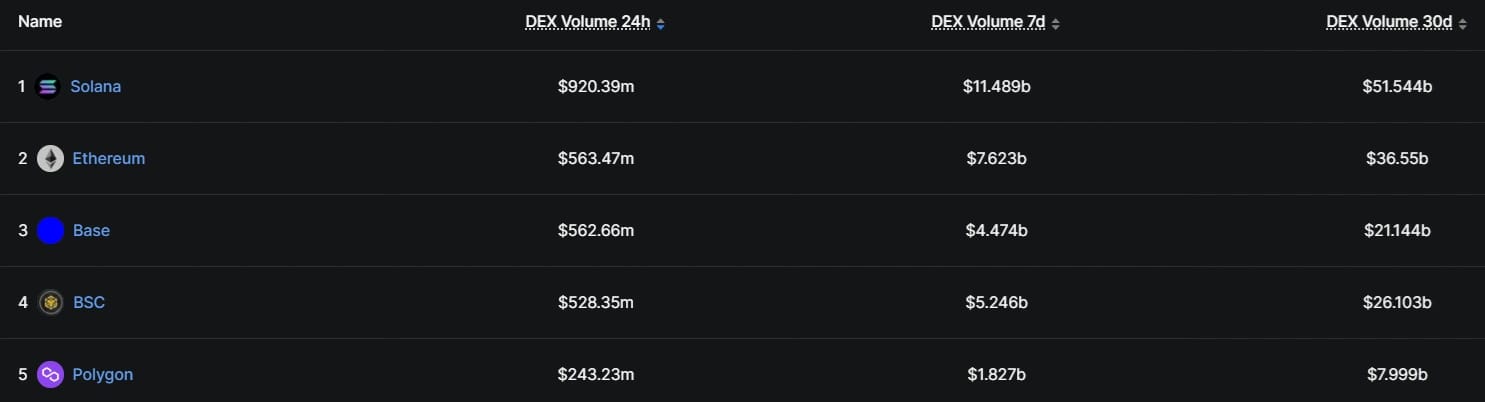
According to data from Defillama, the network processed $920 million in 24-hour DEX spot volume as of April 6, while its rival, Ethereum, trailed behind with $563.47 million.
Headline picks by our Cat

Meme of the day
Join the Conversation!
We'd love to hear your thoughts and comments. Join our community and stay updated with the latest trends and discussions in crypto.
Twitter | Instagram | Telegram Channel | Linkedin | Facebook