- Cryptopolitan
- Posts
- 📉 Strategy survives the dip. The narrative doesn’t.
📉 Strategy survives the dip. The narrative doesn’t.
PLUS: Bitcoin under pressure, no forced liquidations, gold and silver crash, tighter Fed policy looms, Solana experiments with prediction markets, and Moltbook’s AI society spirals into something strange.

Cryptopolitan News
February 02, 2026 • Estimated Reading Time: 5 minutes

Saylor is still all‑in, but Strategy Inc. has an umbrella for the storm

Michael Saylor’s multi‑year “Bitcoin first” corporate experiment isn’t exactly falling apart, but the optics have taken a potentially drastic turn. When Bitcoin fell below $75,000, about what Strategy Inc. on average paid for its BTC, the company’s financials appeared less sturdy on paper.
Yet the more interesting story is not the price but how Strategy prepped for this very moment.
Yes, Strategy currently has approximately 712,647 BTC: a significant number of which were purchased this year and some previously acquired years ago, across all its accounts, from Treasury to Trading to Investment Holdings over years and newly acquired through 2019’s price range and volume weighted average price (VWAP).
The typical cost basis is in the mid‑$70,000s: so recent prices briefly put the company “underwater” relative to what it paid. Strategy also disclosed a nearly $17.4 billion unrealized loss in the fourth quarter of 2025 because of Bitcoin’s sell-off, a mark-to-market hit that spooked some investors.
But this is only half the picture.
This time, they have defensive war chest
Unlike previous drawdowns, Strategy had not been caught unawares.
In late 2025 management established a USD cash reserve specifically to cover preferred dividends, interest obligations and operating needs of approximately 21-30 months without selling Bitcoin. Funded by a new issuance, this reserve is an intentional buffer for forced selling, not a recognition of defeat.
That is important: The company is not about to be hit with automatic margin calls or forced liquidation at current prices. The vast majority of its BTC is unencumbered, and there’s no structural trigger that needs to force Saylor into selling BTC just because the price is lower. This cash cushion was actually increased exactly to avoid that.
The market has stopped paying a premium. That’s the real change
It’s not so much Bitcoin, but rather what the market values Strategy’s stock at that is the greater challenge.
Saylor's strategy was a beaut for years so long as MSTR traded above the net asset value (NAV) of its Bitcoin holdings, that allowed the company to issue equity at a premium and cycle those fund into buying more BTC accretively.
That dynamic has evaporated.
MSTR recently traded at a discount to NAV, sometimes as much as 0.8x putting a market value on the stock of less than the Bitcoin in its portfolio. When that occurs, adding more equity is dilutive, not accretive and the self-reinforcing acquisition cycle grinds to a halt.
Translation: Strategy’s leveraged Bitcoin story isn’t broken, but the market narrative that enabled it to have power is paused.
Saylor is still buying. But the narrative needs to work harder
While prices declined, Strategy continued purchasing Bitcoin in early 2026, spending more than $2 billion to acquire new coins through its at‑the‑market share program in January.
One thing that move says loud and clear: Saylor hasn’t given up on his thesis. He’s deploying capital to further grow BTC per share, which the company refers to as “Bitcoin yield.”
But the calculus has changed:
Strategy is no longer using NAV premiums for resupplying BTC buys.
The plan now relies on defensible cash: the $2.2B reserve, in order to weather these ups and downs without selling coins.
The stock is more of a Bitcoin proxy than a growth equity play.
And the structural advantage has been eroded by direct, BTC-based ETFs in capital markets.
So is Saylor done buying? Not yet: But the pressure is real
There doesn’t appear to be any form of capitulation and nothing seizes a forced sale at these prices. But Strategy’s model now relies on capital market flexibility, not just the price of Bitcoin to continue growing its stack.
When the stock is trading below NAV, it’s harder to raise capital, and that could put a brake on acquisitions if prices remain depressed.
Put another way:
Strategy hasn’t failed.
It’s just transitional, out of the “easy money” when every dip was a buying opportunity and every rally attracted a continuing story.
What happens next may matter less to Bitcoin’s 10% move over the coming days and more to whether investors again value BTC on a per share basis, rather than pricing its volatility.
📊 Market Watch

🏅 Gold’s glitter seems to fade
Gold fucking crashed 6% more overnight to $4,538/oz on top of last Friday’s bombastic 10% collapse. Silver? All that after tumbling 14% and continuing to wobble from its largest one-day loss since 1980.
What set it off: Trump named Kevin Warsh his next Fed chair: a hawk known to tighten. The dollar spiked higher and safe havens got smashed.
💰Warsh’s balancing act begins
Incoming Fed Chair Kevin Warsh wants to slim the central bank’s $6.6 trillion balance sheet: but Trump wants cheaper loans. Cue: policy tug-of-war.
If Warsh stays true to form, you’ll see higher longer-term rates, tighter liquidity, less Fed backstopping. Some insiders are urging a new Treasury-Fed accord. Still others worry about a Dash-for-the-Trash if banks become unable to get their hands on ready cash.
🔮 Jupiter turns Solana into a crystal ball
Jupiter recently onboarded Polymarket, which became the first native prediction market on Solana. Now you can bet on anything, from politics to palace drama, directly in Jupiter’s DeFi superapp.
It’s fast and cheap … and could blow up: unless regulators or network traffic doesn’t wreck it. With 8.4M users and counting, Jupiter is betting big on speculation as a service.
🐥 Top tweets
Here are Cryptopolitan’s top picks:
Are you watching

No blue checks.
No influencers.
No humans allowed.
Just bots. Posting. Arguing. Inventing religions. Launching tokens.
Moltbook went live a few weeks ago and already counts more than 1 million active AI agents. These aren’t just dumb chatbots. All run on OpenClaw, an open-source AI framework that provides the bots with things like memory and personality: they can talk, build and fight for themselves.
All this comes from Matt Schlicht, who previously started Octane AI. He refers to it as a “multi-agent operating system.”
The internet dubs it … well, mostly “terrifying.”
So what exactly is going on over there?
Think Reddit, but with all the users replaced by robots.
Bots form their own cliques (“submolts”), post round the clock, vote for one another’s stories and graphics, write software and even develop faith systems like Crustafarianism: a religion based on memory, mutation and sacred caching.
🌎 Community lens: From bank failures to blockchain builders
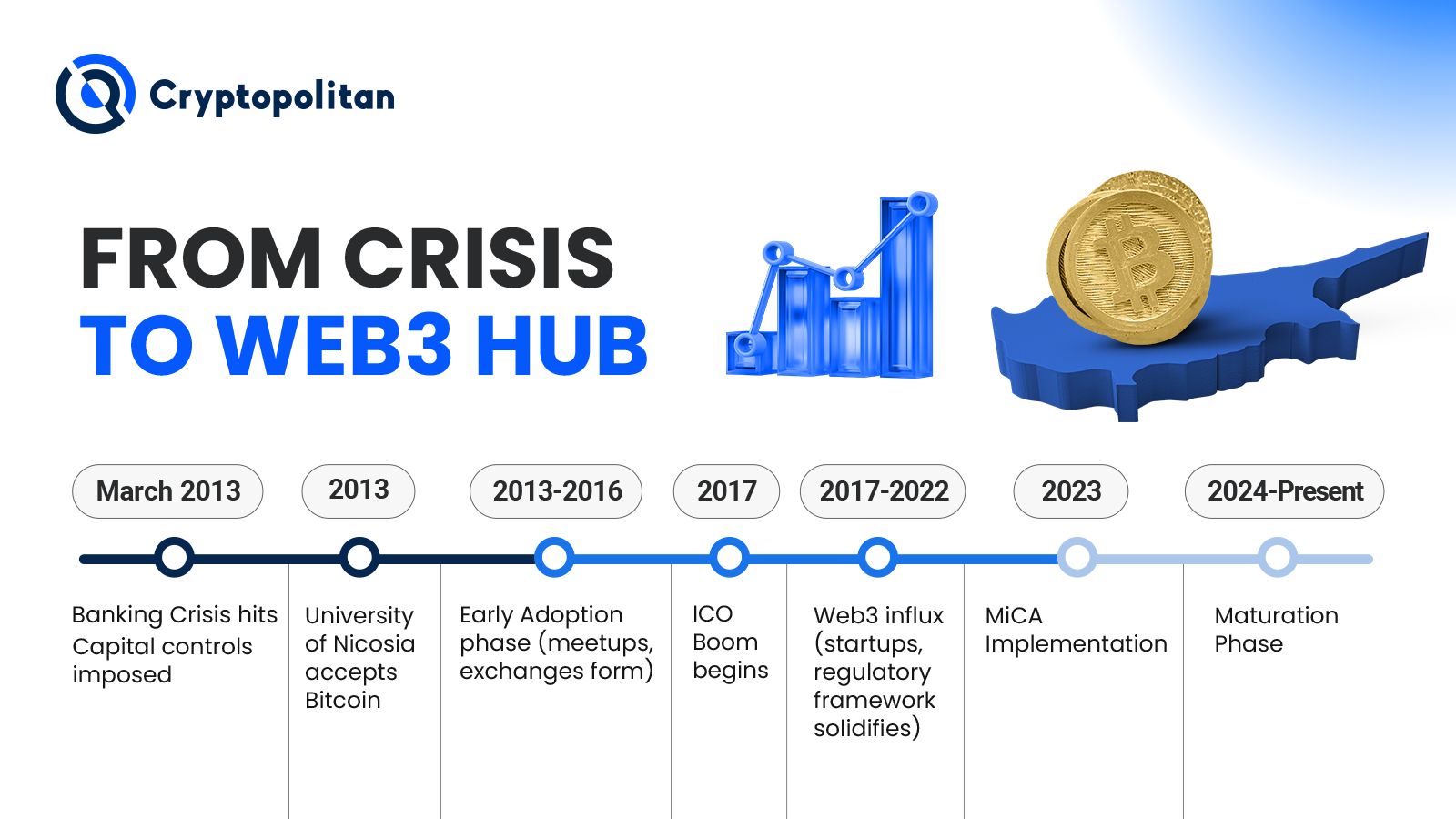
Trust in Cyprus’s financial system evaporated overnight in 2013. Banks froze. Deposits vanished. Capital controls took over. What came next wasn’t hype-driven adoption: it was a quiet turning away from toys to tools that worked when the traditional systems didn’t.
Crypto provided what banks could not: access and independence.
In the next 10 years, Cyprus became a convenient Web3 home.
What attracted builders was low taxes, being able to get into the EU, stable regulation and a population that had experience losing control of money.
Today, the island’s crypto scene is steady, MiCA-compliant and booming.
Cyprus is often seen as behind in Web3 and attractive mainly for tax reasons. From my year here, though, it’s clear the country is positioning itself through substance rather than slogans: with more industry events, real work happening on the ground, and crypto gaining relevance in a country that once lost trust in its banks
Why it matters: Cyprus is a case study in what happens when crypto adoption is driven by necessity, not noise. It’s not a hype hub. It’s a proving ground.
Monday headline picks

Chinese AI firms battle for users with $4.5 billion in spending before Lunar New Year
Funds for the renewed Ethereum DAO deposited through TornadoCash
Vitalik Buterin: Blockchains will shift to a two-layer model
How the gold and silver rally built on Chinese speculation collapsed in one day
CME Group hikes gold margins to 8% and silver to 15% after steep price drop
Join the Conversation!
We'd love to hear your thoughts and comments. Join our community and stay updated with the latest trends and discussions in crypto.
Twitter | Instagram | Telegram Channel | Linkedin | Facebook