- Cryptopolitan
- Posts
- 🤖 The $1 Trillion AI race has begun. OpenAI joined It.
🤖 The $1 Trillion AI race has begun. OpenAI joined It.
PLUS: Tokenized T-bills reach $14 Billion

Cryptopolitan News
April 23, 2026 • Estimated Reading Time: 4 minutes

The $1 Trillion AI race has begun, and Open AI joined it. OpenAI is getting valued as a trillion-dollar company, even before IPO.
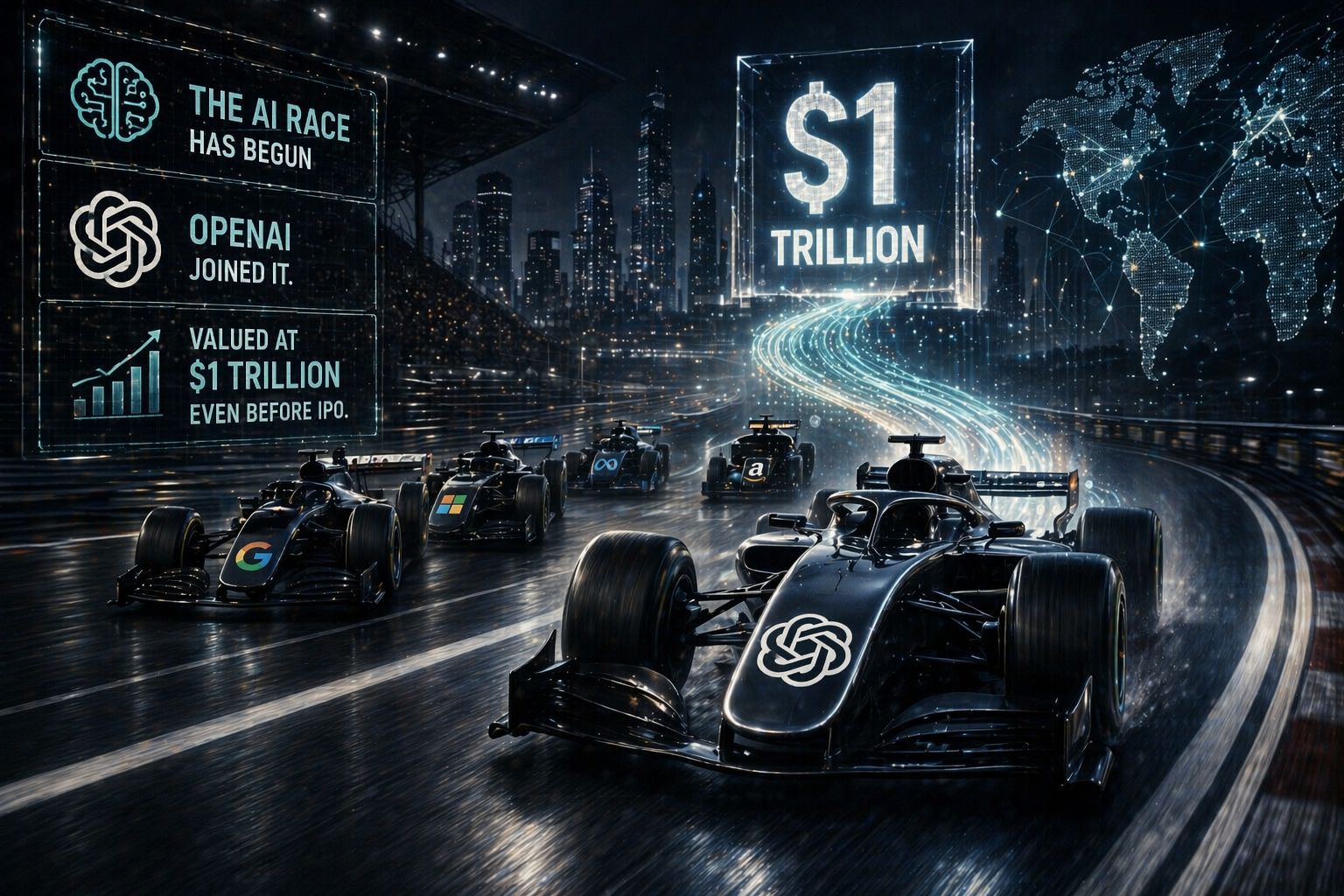
Implied valuation close to $1 trillion from on-chain pre-IPO instruments trading implies they are up >160% since late 2025. This puts OpenAI into a very small, strange club with SpaceX, which is also aiming for about $1.7 trillion, alongside Anthropic (which is approaching the trillions too). This is more than just a funding milestone. It is a sign the next generation of mega-IPOs not be shambles like this one
From idealism to infrastructure
From the start, OpenAI wasn’t meant to be some sort of trillion-dollar company. They began as a more-factual that beget, build AI for humanity head off & stop a handful of companies to control the technology.
When AI was mostly a research-driven field, that model worked. It broke with AI as infrastructure.
This applies to specific software types, and not so much the AI arena where scaling costs are not nearly zero. With every prompt, every image you generate, and every API you call, there is compute being consumed. According to estimates, a ChatGPT query alone would set you back a few cents, whereas the output of images or generating code are going to cost quite a lot more. At scale, those costs go nuclear.
The cost of training frontier models is still higher. It takes an estimated more than $100 million to train GPT-4. We expect the next generation to be in the billions. And that doesn't factor in the maintenance cost of approximately 500,000,000 active users.
This is the reason OpenAI restructured in 2019 to become a capped-profit company (rather than nonprofit). It wasn’t philosophical. It was necessary.
ChatGPT turned distribution into dominance
What was touted originally as a product launch at the end of 2022 turned into one of the most rapid adoption curves in tech history. Two months 100 million users Close to 1 billion users every week by 2026.
Revenue followed just as aggressively. OpenAI went from 200 million in 2022 to more than a $25 billion run rate mark. That growth was accelerated by enterprise adoption, with companies spending $25-$60 per seat per month and large deployments reaching millions annually.
What the market is pricing today:
The distribution layer, not the product. Forget OpenAI is no longer just constructing models. It is turning into the interface by which users engages with AI.
The real constraint: compute
However, this scalability has laid bare a much bigger problem throughout the entire AI landscape.
Compute is now the bottleneck.
GPUs are the main piece of infrastructure that OpenAI, Anthropic and others rely on, and Nvidia controls a big slice of this pie. Large chips can be worth tens of thousands of dollars apiece, but running big clusters costs billions in capex. Microsoft, for instance, has committed tens of billions towards the infrastructure costs for OpenAI and a comparable spend is happening throughout industry as well.
This is in large part why the dynamic is changing.
Claude is similarly gaining with enterprise integrations at Anthropic, reportedly into the multi-billion dollar revenue run rates. xAI: a division within SpaceX developing its compute stack, establishing itself as both infrastructure and application layer
All of us are coming together around one simple truth:
AI is not a software business. It’s a capital-intensive, infrastructure-heavy industry.
A different kind of IPO cycle
It’s this moment that makes it different. The last big tech IPO wave: Facebook, Uber, Airbnb, was propelled by network effects and software margins. Compute, Energy, and Distribution are driving the next generation.
And OpenAI, SpaceX and Anthropic are not merely racing for users. They are fighting for the capital necessary to create and maintain these systems. That capital requirement is really large.
The estimates on the overall cost of AI infrastructure could reach beyond $1 trillion within 10 years. Models and products no longer dominate the field; now, data centers, chips, energy, and cooling are also as critical.
$1T valuation is really what?
The number in the trillions has nothing to do with OpenAI today as a company. It is a speculative bet on who controls the AI stack;
The model layer. The distribution layer. The infrastructure layer.
Currently, OpenAI is positioned right in the center of that stack. The market is beginning to price it as such. The larger question: what happens when these companies eventually go public?
Because for the first time, public markets will not only price growth.
They will price the bill for building it forward.
POLL: We cover AI every week inside Cryptopolitan Daily. Would you want a dedicated daily AI newsletter from us? |
📊 Market Watch

1️⃣ Crypto taxes are coming for you… even on $1 transactions
It turns out Kraken is only about a month late in actually filing the tax forms.
More than 18M were connected to transactions below $1, and almost 75% were less than $50.
Remember, crypto is still considered property, meaning that every transaction, no matter how small the reward or payment, is taxable.
In practice, this means a regime whereby only reporting overhead of emormous proportions, which will continue to grow with increases in small transactions, results from its frequent use.
2️⃣ Tesla is on the rise, but we've heard this story before, and it's changing now
Tesla achieved $22.4B in revenue (+16%) but fell short of expectations The core EV business is performing fine but where the money goes is a bigger signal. Capital expenditures were up 67%, with large outlays for AI, self driving and Optimus robots.
Meanwhile, $786M in Bitcoin holdings were written down on the balance sheet, alongside very little noise from crypto.
Tesla still sells cars: but obviously it wants to be more than that.
3️⃣ Tokenized T-bills reach $14 Billion
With DeFi taking its time, tokenized U.S. Treasuries just hit an on-chain all-time high of $14B in total value locked (TVL).
You are seeing real-world yield, coming to crypto: into Ethereum, Solana and BNB Chain in particular. That’s about $500M+/year in onchain yield at this rate.
It's a slower growth: less hype, more stickiness. It is perfectly starting to look like the basis for the next chapter of DeFi.
🐥 Tweet of the day
Are you watching?
Coinbase have just said it out loud: not much crypto is quantum-ready

In a recent report, they wrote that new networks including Algorand and Aptos are already gearing up for the transition while bigger chains such as Ethereum and Solana have their work cut out.
The threat lies in the future, we are still a good 10+ away from a proper quantum break. However, when it comes, achievable cryptography may be breakable and non-migrated wallets might be vulnerable.
Coinbase’s message is simple:
this problem we are not talking about the future. It’s a planning problem now.
Meme of the day
Join the Conversation!
We'd love to hear your thoughts and comments. Join our community and stay updated with the latest trends and discussions in crypto.
Twitter | Instagram | Telegram Channel | Linkedin | Facebook