- Cryptopolitan
- Posts
- 🔍 Kevin Warsh: The most powerful new person in global finance?
🔍 Kevin Warsh: The most powerful new person in global finance?
PLUS: Sam Altman shoots up on Forbes top billionaires list with a $6.5 billion net worth

Cryptopolitan News
May 14, 2026 • Estimated Reading Time: 5 minutes
The most powerful new person in global finance: Kevin Warsh? He is inheriting inflation, a president who wants cuts, and a Fed that isn't sure it trusts him yet.
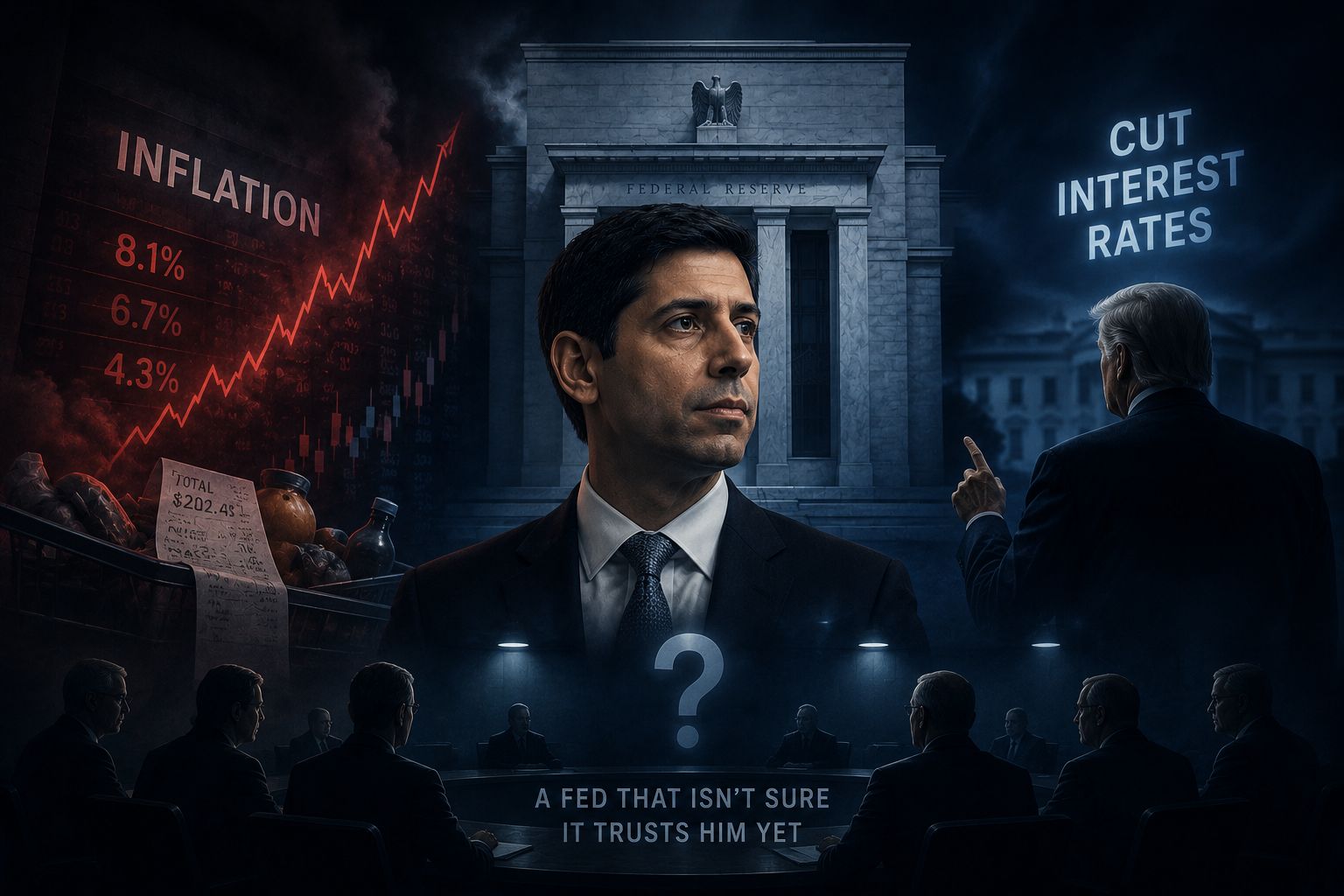
The Senate on Wednesday confirmed Warsh 54-45, the most closely divided and partisan Fed chair vote in modern American history Every Republican voted yes. The only Democrat to vote "yes" was John Fetterman of Pennsylvania, who broke ranks with party leadership to give Warsh the margin he needed. Jerome Powell's term ends Friday. Next up is a 56-year-old Stanford-trained lawyer, who at one point demanded "regime change" at the very institution he now leads.
And the timing could not be less than bad.
The consumer price index for April was 3.8%, the steepest reading since August of 2019. The direct result of the Iran war, and the Strait of Hormuz disruptions driving up gasoline prices over 28% higher than a year ago, energy costs are the number one take away. For the third straight month, core inflation that excludes food and energy increased.
Three committee members flagged that at the last FOMC meeting in April they were as likely to hike as they were cut interest rates. Rates markets are now pricing that no cuts occur until late 2026.
That is the fate Kevin Warsh is walking into.
What it is that Trump wants and what it is that Warsh can actually deliver
Trump has made his expectations clear. In public he has said he would be "very disappointed" if Warsh doesn't follow up with lower rates. It is an issue that the president has been attacking Powell about for years Keep in mind that when Trump chose Powell over Warsh back in 2017, he believed Powell would be more compliant on rates. That relationship soured famously. There is a hush in the markets that history is about to move into rhyme.
To give Warsh credit, he has been consistent on one front during his confirmation process. Speaking directly to the Senate Banking Committee, he said he made no commitments to Trump on rate reductions. He at one point warned the White House to not fire Powell last year, a decision that would have helped his own career but did not. During hearings, Senator Elizabeth Warren called him Trump's "sock puppet". His supporters highlight that Powell intervention as evidence the characterisation is unwarranted.
That's not really what Warsh believes about monetary policy, but you'd never know it from the political framing. He believes the Fed has become too reactive to short-term shifts in data over a long period of time and lost credibility. He is eager to change the way the institution communicates, beginning with getting rid of the dot plot, the quarterly interest rate projections that he believes do more to confuse than clarify.
He has also said he wants to speed up the decline of the Fed balance sheet, which sits at more than $8 trillion, asserting that current tapering schedule for Treasury bonds and mortgage-backed securities is too gradual.
There's nothing dovish about any of that. At best it could help keep rates higher for longer.
The Powell complication
This is where we arrive in this story without a neat historical analogue. Powell is here to stay.
He remains a member of the Board of Governors until January 2028 which means he continues to have a vote on the twelve-member committee that sets interest rates. It has been almost eighty years since a departing Fed chair became a governor. Powell, last month, stated that he would not act as a shadow chair nor would he publicly oppose the successor.
In any case, he retains his vote, and at least three other committee members were already leaning towards rate hikes from the last meeting. That consensus will have to be built inside a institution he recently took over after the most partisan confirmation in history.
The true test lies in the independence of the Fed. Not whether Warsh cuts rates quickly enough to help Trump, but whether the institution will be able to hold onto the credibility it has built over decades as its new chair lives between what his boss wants and what an economy truly needs.
POLL: Who do you prefer as the Fed Chair? |
📊 Market Watch

1️⃣ Kalshi, meanwhile, had its first week processing $1 billion of non-sports weekly volume.
That is 28x growth in the category Polymarket built its entire identity around in just twelve months. Kalshi: not a sports market, but politics, macro, crypto-market & geopolitical contracts, now outpacing Polymarket's equivalent month volume back in May by 2.5x
The drivers are wide: fed rate decisions, geopolitical markets forward Iran war and milking 2026-midterm contracts from early-2025 crypto binary price hedges. Last week Kalshi completed a $1 billion Series F at a $22 billion valuation, enjoying an 800% increase in institutional flow over the past six months.
While the volume of sports aided in building the scale, it also invited every state-level legal challenge. The non-sports number is what tells you if the biz survives what happensfrom there.
2️⃣ On Wednesday, 26 days after a $292 million hack froze the protocol, Kelp rsETH cross-chain bridging re-opened.
Aave deposited the first tranche of 25k rsETH into the LayerZero OFT adapter on Ethereum mainnet (at block 25087631), officially reactivating cross-chain movement for the first time since April 18 exploit.
All paused withdrawals, deposits and exchange rates will resume within 24 hours at the respective prices at time of pause (within 48 for staking rewards accrued during the period), with all benefits from stake ownership being fully credited to holders.
The other 92,132 rsETH will be refilled in staged tranches within two weeks. The bridge is also no longer attested by a single validator, which has now become four independent attestors, with block confirmation thresholds increasing from 42 to 64.
Chainalysis blamed the original attack on Lazarus Group of North Korea via RPC node poisoning. Although the attacker had used a credit line to cover their losses, 30,765 ETH currently worth approximately $72 million is presently held in a wallet controlled by Aave awaiting future release from the courts.
3️⃣ Consensys has just postponed its IPO to autumn 2026.
As a backdrop, the MetaMask parent was seeking to do a private SEC filing by the end of February with lead banks JPMorgan and Goldman Sachs, having last raised capital back in 2022 at a ~7B valuation.
February market crash, Iran war and macro uncertainty surrounding rate cuts killed the timing. Kraken, which made a confidential filing to go public late in 2025, suspended its IPO earlier this year.
This week Ledger suspended its plans to float at a valuation of $4 billion for the same reasons. After completing the lone crypto-native US IPO of 2026 in January, BitGo now changes hands at 36% less than its offering price. But after a dozen crypto companies entered 2026 with plans to list based on regulatory optimism, that bubble of goodwill has quietly deflated.
Are you watching this?
Sam Altman shoots up on Forbes top billionaires list with a $6.5 billion net worth

Sam Altman’s fortune has climbed to more than $6.5 billion, based on Forbes’ latest estimate, after court filings pulled new details about his private company stakes into public view.
Top tweets, picked by our Intern

Gif by 60secdocs on Giphy
NVIDIA is now worth more than the GDP of every country in the world except the USA and China.
Business schools are slashing MBA tuition by as much as 50% due to falling demand.
Elon Musk, Tim Cook, and Nvidia CEO Jensen Huang seen in China with President Trump and Xi Jinping.
President Xi stuns the room saying to Trump: “We should be partners, not rivals"
Meme of the day
Join the Conversation!
We'd love to hear your thoughts and comments. Join our community and stay updated with the latest trends and discussions in crypto.
Twitter | Instagram | Telegram Channel | Linkedin | Facebook