- Cryptopolitan
- Posts
- ⚡️ Elon Musk steals the show at Davos
⚡️ Elon Musk steals the show at Davos
A surprise appearance rewrites the agenda. PLUS: Musk predicts AI outthinking humans by 2027, Larry Fink backs tokenization, gold and silver surge, markets wobble, and crypto braces for regulation.

Cryptopolitan News
January 23, 2026 • Estimated Reading Time: 6 minutes

Two people the crypto industry always has its eye on meet in Davos: Elon Musk and Larry Fink.
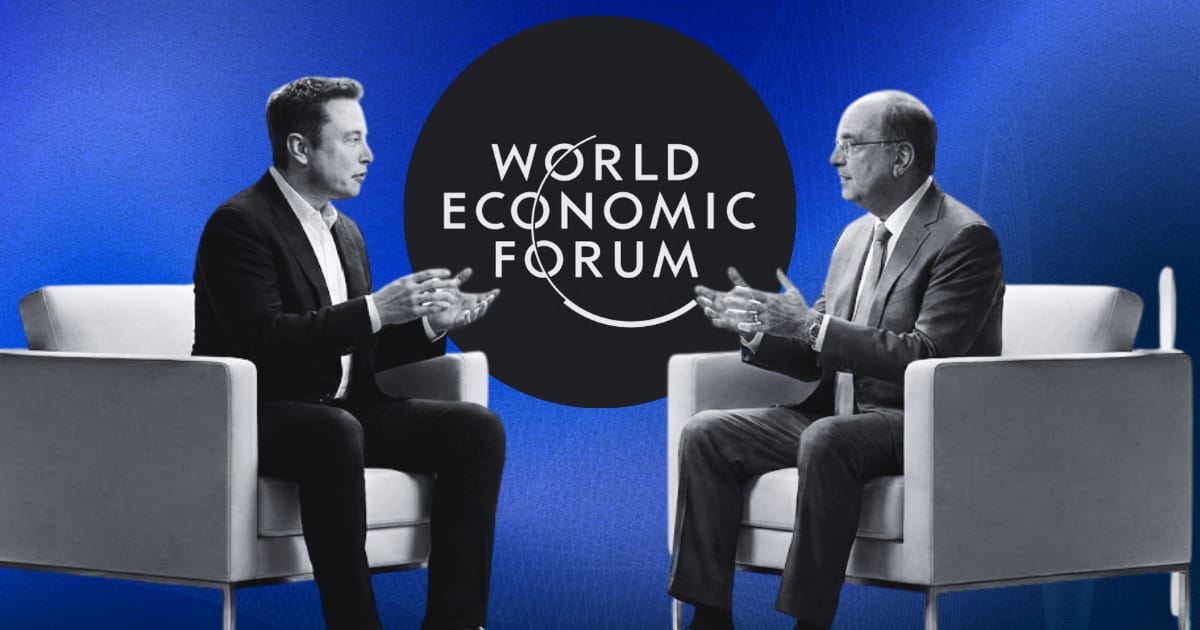
Elon Musk wasn’t supposed to be one of Davos’ headline acts this year. But by midweek, he was himself one of them.
Musk made a surprise appearance at the World Economic Forum where he sat down with BlackRock CEO Larry Fink for a wide-ranging chat that touched hill-and-valley style on everything from AI and robots to solar power, Mars and the fate of humanity.
The exchange was part philosophy and part engineering roadmap, and very Musk.
When Fink asked what success looks like in 10 or 20 years, Musk said he doesn’t pretend to know that far ahead.
On artificial intelligence, though, he spoke with rare certitude. Musk claimed that AI is poised to exceed any single human its capacity to think by the end of this year, and expects AIs will out-think all humans combined by 2027.
That acceleration, he argued, is where optimism comes into play. “It’s optimistic, but you know, I would rather be optimistic and wrong than pessimistic and right,” Musk told the audience at the conclusion of the session.
From science fiction to reality
Pressed on what influenced his career, Musk said it linked to his passions as a child of science fiction writing, fantasy novels and comic books. He said he never thought that one day, here he would be, but all along his ambition has been straightforward: to make science fiction real.
He held on to Star Trek in particular. Musk wants a real version of Starfleet: huge ships exploring other planets and star systems, he said. That curiosity, he said, still informs everything he constructs.
He called his perspective a “philosophy of curiosity”: investigate the structure of the universe, what life is about and whether our current physics models might be wrong. AI, he feels, will enable humans to ask better questions, questions we may not yet be intelligent enough to frame, even.
On the inevitable Mars question, Musk added that he would probably go himself someday. Does that mean dying on Mars? he was asked.“Yes — just not on impact,” he joked.
Energy, robots and the real AI bottleneck
And as his talk shifted from philosophy to infrastructure, Musk honed in on what he believes is the true bottleneck on AI’s forward march: power, not chips.
AI hardware production, he pointed out, is growing exponentially but global electricity generation is increasing at a mere 4 – 5% annually. That mismatch, he cautioned, could come as soon as this year, when the world might find itself with more AI chips than it can actually power. China, he said, is the outlier:
China has by far the most advanced government policies but I think it is natural because China is on an order of magnitude more populous than other countries, I’d like to be clear that I am not putting down China, quite the opposite. They are very efficiently and very quickly deploying solar power and they have deployed at a scale that we cannot match.
According to Musk, energy was long overdue for rationalization as a strategic advantage because of geopolitical challenges associated with energy. He added that SpaceX wants to launch solar-powered AI satellites in the years ahead, as space provides more efficient solar input than Earth.
Robotics was another major theme. Musk said Tesla’s humanoid robots Optimus are already doing some basic tasks in factories.
By late 2027, he anticipates robots to be dependable enough for public purchase. Ultimately he expects there to be more robots than people in the world, and with broad robotics adoption could come life without scarcity and a massive boost to living standards.
What’s going on with the markets?
Musk’s appearance came during a tumultuous week on global markets. Gold jumped to an intraday high just below $5,000 and silver raced towards the 100$/oz mark. With the world reconciling with geopolitical tension, slowing growth and the rapid pace of technological change, crypto and equities moved as investors attempted to price what that adjustment would look like.
🪙 Cryptopolitan’s take
The wider lesson of Davos was not so much any individual prediction but tone. While the rest of the attendees hassled over trade, tariffs and regulations, Musk framed a radically divergent view: abundance vs. scarcity; automation vs. toil; upending how humans live on Earth versus limiting its future through energy production and artificial intelligence (AI), which must be reduced, if we are able to responsibly scale nuclear or AI at all.
As Davos was winding down, Fink called Musk a “close friend” and explained he is constantly inspired by him. Musk closed with the usual message, but it struck differently in a year when so much has been uncertain.
The future, he added, is a worthy thing to build toward and to believe in.
Quick poll (optional): Do you think Musk’s Davos message was… |

📊 Market Watch

🧠 Buterin vs the Masses
Vitalik Buterin is betting that the future of money is free from oversight, and taking some heat for it. From criticism of 2025 as a failure in decentralization the Ethereum co-founder shot back, demanding critics build better tools instead of relying on centralized defaults.
Vitalik is already in the process of replacing Google Maps with OrganicMaps, Gmail with Proton, Telegram with Signal and currently testing local AI and privacy-first UX.
His point? Freedom takes friction, perhaps even diminished reach. Critics say he’s alienating himself from the Ethereum community. But Vitalik considers such revolt essential.
If this move catches on, 2026 might be the year the crypto industry’s builders stop chasing mass appeal and start choosing principles over popularity.
🔐 Bitcoin vs Quantum panic
Is a quantum computing bloom coat-tailing Bitcoin’s price rally? According to Glassnode, no: it’s long-term holders selling and not qubit cracking keys. But the debate is heating up.
Other traditional finance voices, including Jefferies’ Christopher Wood, have dropped BTC from portfolios on the pretext of quantum risks. Others like Nic Carter believe quantum fear is the story of 2026. IBM and Google boast of breakthroughs, but there’s still no proof ECC is busted.
In the meantime, the bigger truth may be psychological: Big-money players are beginning to price in long-term risks, even if the tech isn’t there.
🇺🇸 Trump eyes Powell’s replacement
Former Fed Chair Jerome Powell’s term ends in May, and Trump says he already has a successor picked. He won’t say who, but suggests it is someone “respected and well-known,” with Rick Rieder, Kevin Hassett and Christopher Waller all being rumored choices.
Behind the scenes, Trump has been urging rate cuts more aggressive than those Powell finally delivered but has also calling out the ‘slow” pace of Powell’s decision-making. His administration has even provoked a criminal investigation into the Fed’s HQ renovation: an act Powell describes as retaliation.
Markets aren’t quite sure what to make of it yet, but one thing’s certain: monetary policy in the US may soon get a new pilot, and it won’t be flying on making no noise.
📈 IPO Watch:
BitGo opens the Crypto listings for 2026
This IPO is not simply a milestone for BitGo but more broadly, a test of the waters for the industry.
With Bitcoin held under $100K, regulatory bills surrounded in limbo and investor caution carrying over from last October's selloff, BitGo’s profitability and consistent revenue streams through custody, staking and fees stood out. It underscored that infrastructure players, not hype tokens may be best suited to weather crypto’s maturing phase.
Who’s next:
Kraken and Grayscale are considering similar options.
Circle and Figure could bounce back with follow-ons.
Market mood could be influenced by two AI giants, Anthropic and OpenAI, thinking of going public.
🐥 Top tweets
Here are Cryptopolitan’s top picks:
⚖️ Regulation Watch
The Senate’s new and improved market structure bill is going to mark-up next week, but bipartisan support is eroding.
The new version drops Democrat Cory Booker, who was a key negotiator. Should the bill move forward, it is likely to do so along party lines, a far cry from the 47–6 bipartisan vote that pushed through the House version.
Industry reaction is mixed. Coinbase dropped its support, while a16z supported the bill as it was written. The Blockchain Association blasted bank lobbying, and the CEO of Binance said, in effect, that any regulation is better than no regulation.
The bill does contain some industry victories: It protects noncustodial developers and infrastructure providers, funds the CFTC with user platform fees and also introduces guidelines for meme coins created to speculate. But that’s been insufficient to bring lawmakers or the crypto industry together.
And the Senate Banking Committee has put things on pause, according to reports preferring housing over crypto. Negotiations with Coinbase and big banks around yield products haven’t moved forward, and there’s a February recess to get through first, which means progress could take even longer.
The bottom line: Crypto regulation is still kicking, but it remains bogged down by political gridlock, industry discord and competing priorities in D.C.
Friday headline picks

GoMining, Jacob & Co. tout $40K Bitcoin watch with ‘digital miner’ gimmick
Solana Treasury firm faces insider trading claims after meme coin launch
Amazon bulls say AWS cloud momentum could finally reboot stock sentiment
Ripple CEO Brad Garlinghouse predicts 2026 will be crypto’s best performing year ever
Meme of the day

Join the Conversation!
We'd love to hear your thoughts and comments. Join our community and stay updated with the latest trends and discussions in crypto.
Twitter | Instagram | Telegram Channel | Linkedin | Facebook