- Cryptopolitan
- Posts
- 🤫 Sam Altman is surprised by how GenZ uses AI
🤫 Sam Altman is surprised by how GenZ uses AI
PLUS: Anthropic has just cancelled all secondary trades of its stock without permission.

Cryptopolitan News
May 12, 2026 • Estimated Reading Time: 5 minutes
A year ago Sam Altman said some words, and it is getting more and more true. A generation is being brought up not to form an opinion without consulting an AI first.
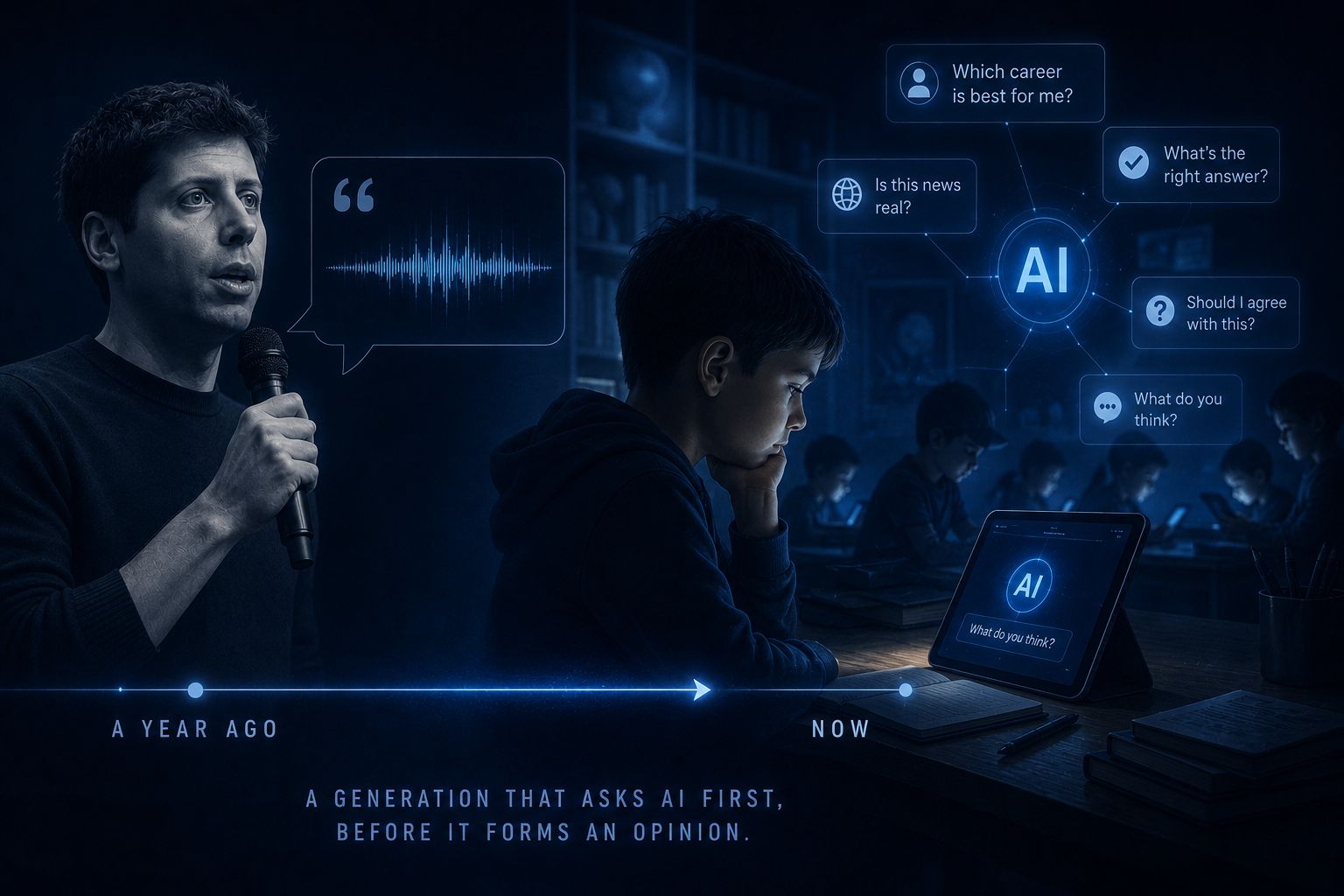
OpenAI's CEO showed a generational view of how ChatGPT is being used at the AI Ascent event hosted by Sequoia Capital. The older users treat it as a smart Google. Guys in their 20s and 30s are treating it like Life, The Adviser. It is like an operating system for college students.
That last group is the one to pay attention to.
These students came to campus in 2022 when ChatGPT debuted, and now they are graduating from college into an increasingly high-technology set of industries that has never before known a world without it. They were not reluctant adopters or experimental ones when it came to AI. They made their academic infrastructure totally on that.
Lecture notes, Summaries of research papers, Archived codes, Scheduling, Drafts of writing assignments, Preparation for an exam. All of it running via the same interface, with memory that context from all past conversations they have had over it.
Altman noted that they have 'memorized these fairly complex prompts... that they paste in and out.' This isn't casual use; it’s a systematic workflow.
The life decisions part
It was not the productivity part of Altman's remarks, which generated the most reaction. It was this:
They literally don't make life choices without going to ChatGPT and asking it what they should do.
He was not criticising it. It was natural as an outgrowth of what memory-enhanced AI really is. ChatGPT knows who your friends, what the relationship history resemble and how long they were worried about what we have been planning. It knows more about a person on their day to day than most people embedded in that person's life. It is, from one perspective, totally sensible to ask it for advice before taking a big step.
The adoption pattern is confirmed by OpenAI's own data. The fastest growing demographic of the product is the college aged adult, over one-third of Americans 18 to 24 years old use ChatGPT. By 2024, Pew Research found that it had been used by 26 per cent of us teenagers for schoolwork, up from 13 per cent a year earlier ChatGPT is currently used by 800 million people all over the world. A research curiosity product launched in November 2022 has become the fastest consumer technology to reach rapid adoption.
What this actually changes
Altman drew a parallel with the smartphone moment. Every teenager adapted instantly. Basic functions took adults three years. This is happening with AI too, only the gap of how the two groups make use of it is larger and the implications greater when one does.
How smartphones changed the way people communicated and localized. Artificial Intelligence is revolutionizing how humans perceive, research, determine and create. This generation didn't just grow up with it and is much more comfortable with the interface. They are learning new cognitive behaviours: outsourcing memory and decision support to a system that has perfect recall and is always there.
Universities are still catching up.
While most schools permitted only limited use of AI, they imposed disclosure requirements. Some have tightened restrictions. None of which has really come to terms with the fact that their students have partially integrated these tools into their intellectual lives as if they had only been grafted onto something inherent in non-institutionalised education over which the institution has no real control.
Some researchers see this as an issue. Several studies have pointed out that ChatGPT can be overly authoritative in its tone when incorrect, and the authors caution that dependence on AI advice for high stakes personal decisions is problematic. A study from 2023 described large language models as "fundamentally sociopathic" in their advising, structurally unsuited to the empathy necessary for any real guidance. But other research shows that for complete AI assistance in day to day decision-making and even the organisation of day to day life, it seems pretty harmless and actually quite useful.
No one has fully priced in it
But the issue with AI advice vs good or bad advice is more a presentational one. A generation is getting in the practice of externalising judgement. Search engines already revolutionized information retrieval. They train you about what should be done, not what is right.
What that does to decision-making, to cognitive autonomy, like will I be able to continue practising uncertainty and expressing thought by deliberation, what happens when you have the wristband over an adult life of daily usage? Nobody yet knows. This year sees the first cohort of students graduates. The data does not exist.
And Altman appeared fascinated, not frightened. This is either the correct read on a tool that augments the human and machine dynamic, or it is conventionally one of the most catastrophic blind spots in consumer technology history. Probably some of both.
POLL: Do you consult AI before making a life decision? |
📊 Market Watch

1️⃣ Anthropic has just cancelled all secondary trades of its stock without permission. Nothing now exists for buyers on Forge and Hiive.
Anthropic issued a statement saying any transfer of Anthropic shares without the explicit consent of its board "is void and will not be recorded on our books and records."
The statement alleges that Forge Global and Hiive as well as five other platforms are unauthorized, and that direct sales, SPVs, forward contracts and tokenized securities even if marketed to certain investors are not exempt.
The term "void" is the most extreme legal stance possible under Delaware law.
2️⃣ Last week was the best inflow week for Solana ETFs in over 7 months with $47M of new capital coming into these products. Traders are eyeing $120.
Last week, net inflows into spot SOL ETFs reached just over $39 million, topped by Bitwise's BSOL at $36 million. The SOL is up just over 15% on the week, trading at around $97 From May 1 to the present, futures open interest has changed from $4.94 billion to $6.4 billion, funding rates are holding steady at +0.065%, and SOL broke its 100-day EMA for the first time since October 2025.
Analysts expect minimal resistance in the range of $95-$120, with the gap forcing a momentum-collecting quick price rise if enough buying persists. Short-term momentum has eased at around $95 to $96 and traders keep an eye on the key support level near $89 to $91.
3️⃣ OpenAI renegotiated its Microsoft deal and saved itself $97 billion in payments through 2030.
Under the original deal, OpenAI had to pay Microsoft 20% of all revenue through 2030, a potential total across the whole period of $135 billion payable as if it were a debt. The new terms will limit total partner revenue-receive sharing to 8% to 10% by 2030, and eliminate the AGI milestone clause that could have triggered potentially larger money payouts.
In return for this Microsoft received a 27% equity stake in OpenAI Group PBC equivalent to $135 billion, a $250 billion Azure spend commitment and IP access until 2032.
The agreement also put an end to Microsoft's cloud exclusivity, giving OpenAI the ability to commercialize through AWS and Google Cloud. One such war between Microsoft and AWS was recently embroiled with a separate $50 billion deal, which is still tangled up in litigation. OpenAI is planning to go public in Q4 and Azure exclusivity and the AGI payment trigger were among the last structural hurdles before going public.
Are you watching this?
Swatch x Solana x AP: a new watch in the making
Top tweets, picked by our Cat

Meme of the day
Join the Conversation!
We'd love to hear your thoughts and comments. Join our community and stay updated with the latest trends and discussions in crypto.
Twitter | Instagram | Telegram Channel | Linkedin | Facebook